
試作から量産まで: IoT 製品を適切に拡張する方法
Building an IoT prototype is exciting. You can finally see the idea becoming a real device. The BLE tag can broadcast data. The sensor can collect temperature or motion information. The GPS tracker can send location data. The mobile app or platform can receive the data correctly.
But here is the real challenge: a working prototype does not automatically mean the product is ready for mass production.
This is a very common pain point for IoT startups and hardware teams. The first 10 samples may work well in the lab, but when the project moves to 500, 5,000, または 50,000 units, many hidden problems start to appear. Battery life may not be consistent. The antenna performance may change after the enclosure is adjusted. The waterproof structure may fail during testing. The firmware burning process may be too slow. The assembly process may depend too much on manual work.
That is why scaling an IoT product needs a clear engineering and manufacturing process.
Prototype Is Only the Beginning
A prototype is mainly used to prove that the idea is possible. この段階では, the team usually focuses on core functions: 無線通信, sensor data, battery power, basic firmware, and product appearance.
例えば, if you are developing a BLE asset tracking tag, the prototype may already support broadcasting, 動き検出, and app connection. If you are developing a temperature sensor, the prototype may already collect and upload data correctly.
しかし, prototype samples are often handmade or semi-handmade. Engineers may manually solder parts, adjust the firmware one by one, or use temporary materials for the enclosure. This is fine for early testing, but it is not enough for stable production.
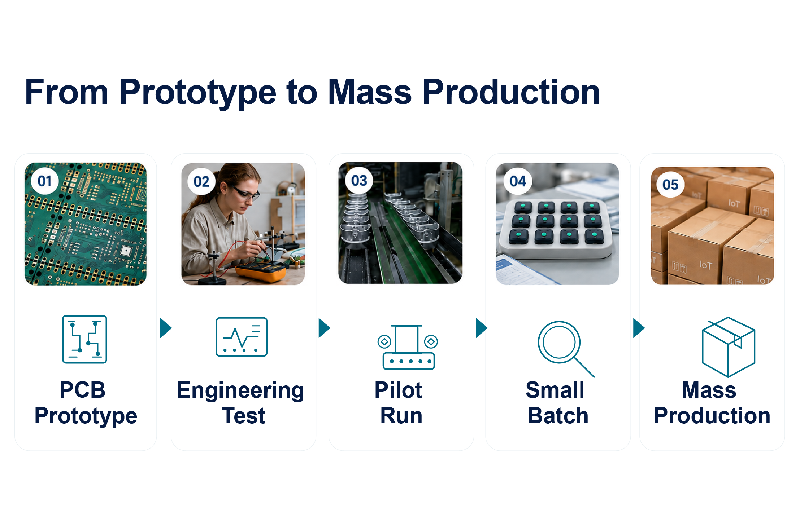
量産前, the product must go through several important stages: EVT, DVT, PVT, NPI, DFM, and Pilot Run.
EVT: Engineering Validation Test
EVT stands for Engineering Validation Test. This stage checks whether the product design can work from an engineering point of view.
In an IoT project, EVT usually focuses on the key technical parts: PCB design, wireless performance, 消費電力, sensor accuracy, ファームウェアロジック, charging circuit, アンテナ設計, and basic enclosure structure.
例えば, does the BLE signal still work well when the device is placed inside a warehouse? Does the battery meet the expected lifetime? Does the GPS module perform well outdoors? Does the accelerometer wake up correctly when movement is detected?
EVT is not about making the product beautiful. It is about finding technical risks early. If something is wrong, this is still a good time to change the design.
DVT: Design Validation Test
After EVT, the next step is DVT, or Design Validation Test.
この段階では, the product design becomes closer to the final version. The enclosure, PCB, バッテリー, アンテナ, センサー, and firmware should all be more stable. The goal is to check whether the product can meet real use requirements.
For IoT products, DVT may include waterproof testing, drop testing, temperature testing, signal range testing, battery aging testing, firmware stability testing, and installation testing.
This stage is very important because IoT devices are often used in real and sometimes harsh environments. A product may be attached to a metal container, installed on outdoor equipment, placed in a cold chain box, worn by workers, or used inside a hospital or warehouse.
A design that works in the office may not always work in the field. DVT helps the team find these real-world problems before production starts.
PVT: Production Validation Test
PVT means Production Validation Test. This stage checks whether the product can be produced consistently using the planned manufacturing process.
This is where many hardware teams realize that “design works” and “production works” are not the same thing.
During PVT, the manufacturer needs to verify the production line, assembly process, testing tools, firmware programming method, packaging process, and quality control standards.
例えば, can the PCB be assembled with a stable yield rate? Can workers install the battery and enclosure efficiently? Can each device be tested quickly before shipment? Can the firmware be programmed in batches? Can the QR code, MAC address, or product ID be managed correctly?
For IoT products, this is especially important because each device may need unique data, such as Bluetooth MAC address, device ID, QRコード, serial number, or cloud platform binding information.
If this process is not well managed, mass production can become messy very quickly.
NPI: Turning Design into a Real Product
NPI stands for New Product Introduction. It is the process of moving a product from engineering development into production.
A good NPI process connects R&d, supply chain, manufacturing, quality control, and project management. It makes sure that all teams understand what needs to be produced, how it should be produced, and how quality should be controlled.
For an IoT product, NPI may include BOM confirmation, component sourcing, tooling preparation, test fixture development, firmware burning process, packaging design, inspection standards, and production documentation.
Many startups underestimate this stage. They may think that once the prototype is ready, the factory can simply start production. In reality, without a clear NPI process, the project may face delays, quality issues, or unexpected cost increases.
DFM: Design for Manufacturing
DFM means Design for Manufacturing. It helps make sure the product is not only functional, but also easy and stable to produce.
例えば, a prototype enclosure may look good, but it may be difficult to assemble. A PCB may work well, but some components may be too close to the edge. A battery connector may be hard to install during production. A waterproof structure may require too much manual glue, which can cause inconsistent quality.
DFM helps avoid these problems before mass production.
For IoT products, DFM can also improve antenna placement, battery installation, enclosure structure, testing points, and assembly efficiency. A small design improvement may save a lot of time and cost when producing thousands of units.
パイロットラン: Testing Before Full Production
Before full mass production, it is usually safer to run a small pilot batch first.
A Pilot Run may include 100, 300, 500, または 1,000 units, depending on the project. The purpose is to test the full production process with real materials, real workers, real test fixtures, and real quality standards.
This step helps the team answer practical questions:
Is the production yield acceptable?
Are there repeated defects?
Is the testing process fast enough?
Is the packaging suitable for shipping?
Are the product labels and QR codes correct?
Is the firmware stable after batch programming?
For startups, Pilot Run is a smart way to reduce risk before placing a large order.
From ODM Development to Mass Production
A good ODM partner can support the full journey from prototype to mass production. In the early stage, the ODM team helps with product design, PCB development, ファームウェア, 筐体設計, and sample testing. In the later stage, the focus moves to NPI, DFM, supply chain, quality control, and production management.
This is where engineering experience becomes very important. IoT products are not just plastic cases with electronics inside. They need stable wireless performance, reliable battery life, accurate sensors, and consistent production quality.
Hybrid Manufacturing Model
For many startups, a hybrid manufacturing model can be a practical choice.
This means the startup does not need to rely on only one model from day one. They can work with a flexible ODM partner for design, プロトタイピング, engineering validation, そしてパイロット制作. When the product becomes mature and demand increases, the production model can be expanded with larger manufacturing resources if needed.
This model gives startups both flexibility and scalability. They can move fast in the early stage, reduce development risk, and still prepare for future mass production.
結論
Scaling an IoT product successfully is not just about producing more units. It is about making sure the product can be manufactured consistently, tested properly, and used reliably in the real world.
From EVT to DVT, from PVT to Pilot Run, every step helps reduce risk. With strong NPI, good DFM, and the right ODM partner, startups can move from prototype to mass production with more confidence.
For IoT companies, the goal is not only to build a working sample. The real goal is to build a product that can survive real customers, real environments, and real production.